

Blog
4 August 2026Blog
4 August 2026Decision State: The Missing Abstraction in Modern Warfighter Software
Why machine-speed operations require a governed reasoning layer between information and command execution
blog post, thought leadership
For more than three decades, defense modernization has pursued information superiority. Nations invested in advanced sensors, resilient networks, modern command-and-control systems, and sophisticated weapons. Those investments transformed warfare by enabling forces to collect, share, and act on information at unprecedented scale.
That success has created a new challenge. Every additional sensor increases the evidence to be interpreted. Every weapon expands the set of possible responses. Every autonomous system introduces new capabilities, interactions, and authority questions. Meanwhile, engagement timelines are compressing as forces confront drone swarms, maneuvering missiles, hypersonic threats, and coordinated attacks designed to saturate defenses. The result is a decisional crisis: adversary systems may synchronize and strike faster than friendly forces can generate and sustain combat power.
The decisive gap is therefore no longer simply collection or delivery. It is the ability to transform information into coherent action on timelines that increasingly exceed unaided human cognitive capacity. Information superiority remains necessary, but it is not sufficient. The advantage belongs to the force that converts information into effective, accountable action first.
This challenge can be understood as Decision Scale: the combinatorial growth in the number, interdependence, speed, and complexity of decisions required to coordinate sensors, shooters, operators, autonomous systems, and command structures across a connected battlespace. During a counter-unmanned aircraft engagement, even a small raid can create dozens of interdependent sensor-tasking, identification, prioritization, and weapon-assignment choices within seconds.
Modernization efforts such as JADC2, Integrated Fires, counter-UAS, homeland defense, and space warfighting all encounter the same reality. Connected systems increase the volume of required decisions beyond what legacy C2 processes were designed to manage efficiently. Additional screens, alerts, and data feeds often intensify the burden. Data integration is not decision integration, and making information available does not by itself produce synchronized action. The challenge also includes semantic interoperability: systems, models, and operators must share enough meaning for data to mature into decisions.
Today’s systems are effective at collecting and displaying information but often leave the most consequential operational questions unanswered: What is the threat? How certain are we? Which sensor should be tasked next? Which shooter is feasible? How should magazine depth affect the engagement sequence? What are the consequences of acting, waiting, or preserving inventory? Why should a particular action occur now?
Traditional systems maintain tracks, messages, plans, a common operating picture, and execution status. Those representations are essential, but none captures the complete state required to make and govern an operational decision. Decision state fills that gap. It is a continuously evolving representation of the information, context, permissions, resources, alternatives, consequences, and time that determine what action is appropriate now.
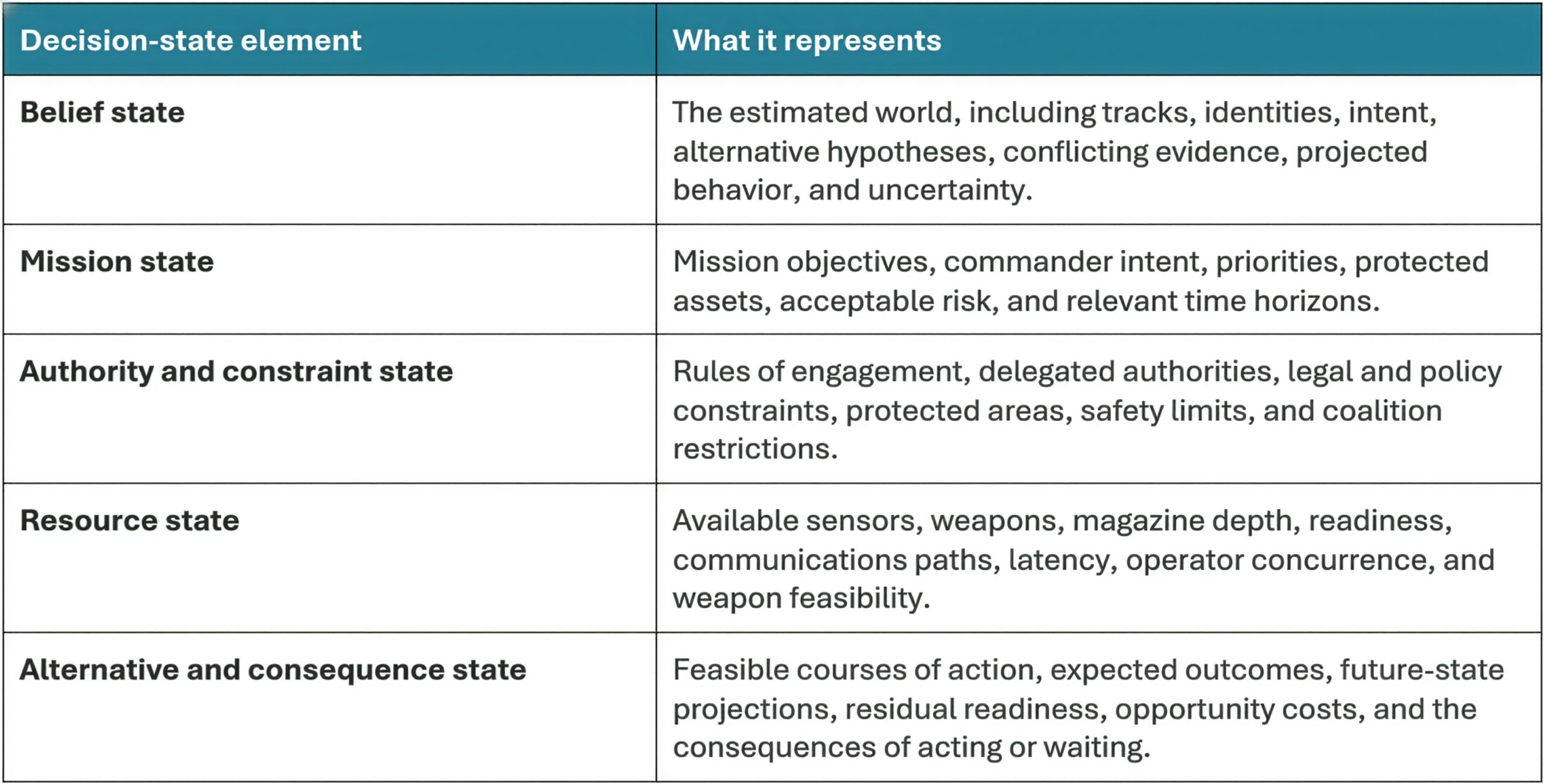
Decision state also records the confidence associated with recommendations, the conditions that could change them, and the provenance connecting conclusions to evidence, models, assumptions, and time-stamped lineage. It maintains truth over time by correcting invalid assertions, resolving conflicting beliefs, retracting stale information, and incorporating new facts as they emerge. As targets maneuver, resources shift, communications degrade, and operators intervene, decision state evolves with the mission rather than treating each event as an isolated transaction.
This concept extends beyond projected situational awareness. Decision state does not merely estimate what may happen next; it also represents what the mission is trying to achieve, what action is authorized, what resources are available, which alternatives remain feasible, and how long the force has to decide and act.
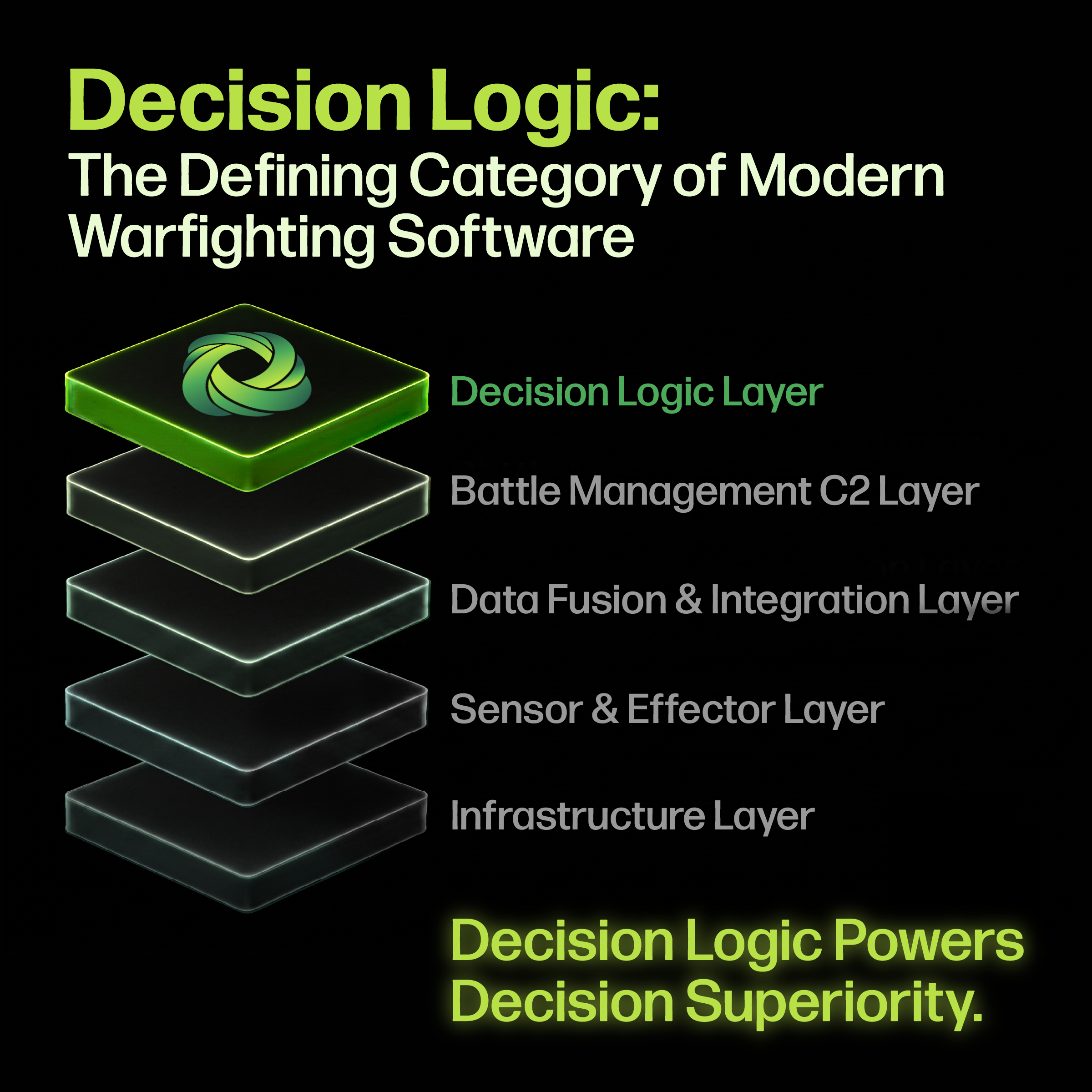
Figure 1. Decision Logic as the governed layer that maintains and reasons over Decision State.
Decision state unifies belief, mission, authority, resources, alternatives, consequences, and time.
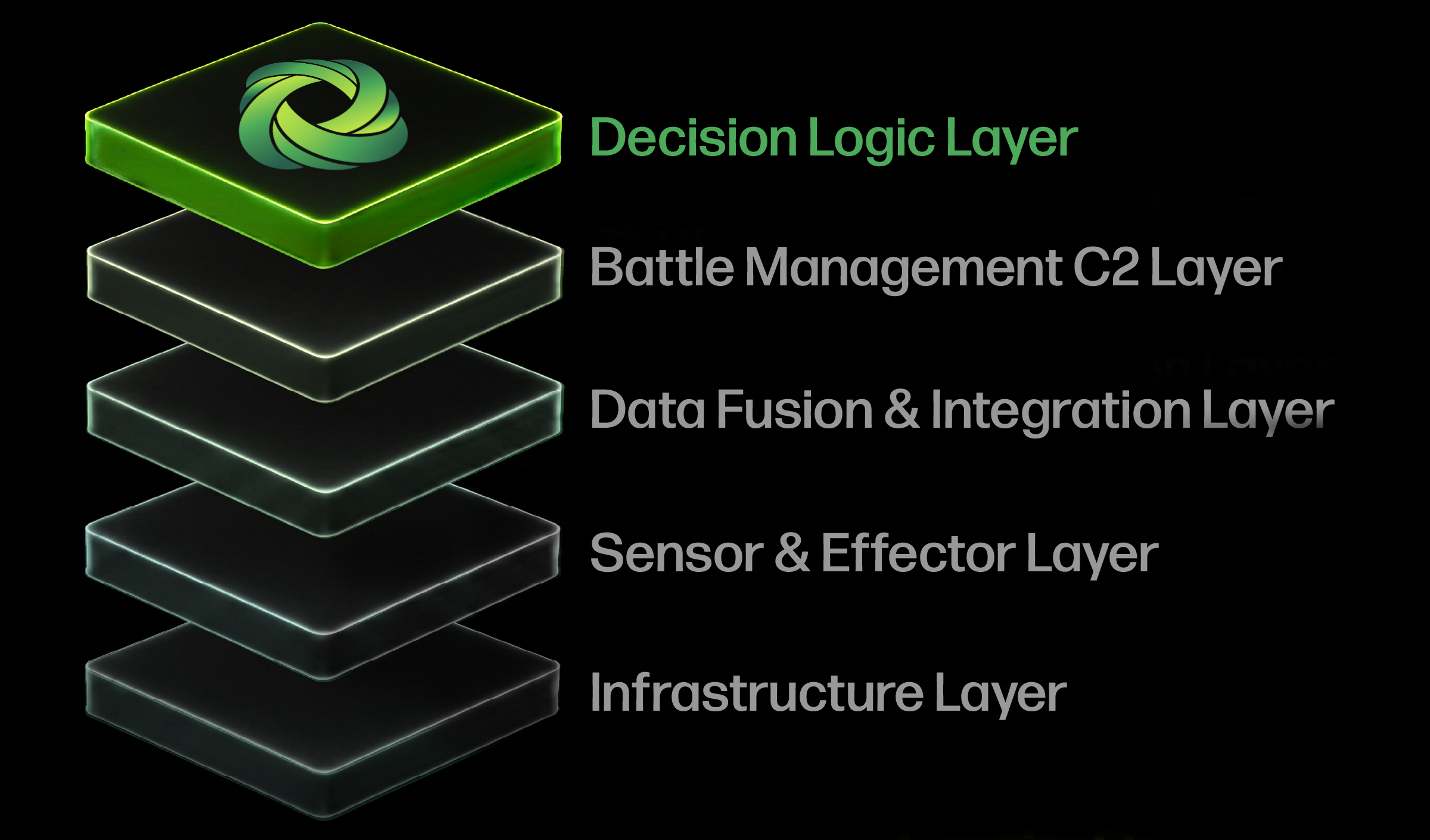
Decision Logic is the governed reasoning layer between information services and command execution. Its defining function is not merely to run an AI model or trigger a recommendation. It continuously constructs, updates, evaluates, and acts upon decision state.
A classifier may identify a threat. A tracker may estimate state. A predictor may estimate future behavior. An optimizer may assign weapons. A language model may summarize context. None of these components alone possesses mission objectives, operational authority, resource awareness, policy constraints, temporal continuity, or accountability for an integrated operational recommendation. The central engineering problem is therefore the orchestration of heterogeneous forms of reasoning—and the governance of their interaction—to produce a coherent, explainable, bounded, and testable decision process.
A credible architecture follows a disciplined cycle:
Each stage reads from and writes to the decision state:
This lifecycle supports consistency, accountability, simulation-based evaluation, and the evidence required for assurance and certification. It also accommodates model disagreement, adversary prediction, temporal reasoning, and bounded abstention when uncertainty exceeds delegated limits.
C2 manages command authority, coordination, mission execution, and the authoritative operational picture. Decision Logic evaluates what should happen next by maintaining and reasoning over decision state. The two must work together, but they should not be architecturally conflated.
Mission-critical C2 systems follow deliberately controlled updates and certification cycles. Decision-making technology must keep pace with a faster-moving landscape of models, optimization methods, threat behaviors, and policy changes, each of which requires independent validation. A separate reasoning layer allows decision capabilities to evolve and be tested on their own cadence without forcing every update to become a redesign or wholesale recertification of the trusted C2 platform.
Air and missile defense, homeland defense, counter-UAS, joint fires, and space operations impose different objectives, authorities, constraints, resources, and timelines. A common Decision Logic architecture can support mission-specific reasoning while preserving the underlying C2 infrastructure and command relationships.
Future operations will span multiple services, domains, allies, vendors, and execution systems. No single C2 platform will dominate every mission. Embedding separate and inconsistent decision logic inside each C2 system fragments governance, assurance, and model evolution. Platform-independent interfaces allow common reasoning patterns to be instantiated across systems while preserving mission-specific configuration, system choice, and command authority.
Operational decision systems rarely receive complete, consistent, or timely information. They must operate with degraded communications, conflicting sensor reports, deceptive behavior, changing resources, uncertain intent, and evolving rules. Decision Logic must therefore maintain alternative hypotheses, calibrate its estimates, detect novelty and out-of-distribution conditions, arbitrate model disagreement, and know when uncertainty exceeds delegated bounds.
The system should distinguish estimated event probability from uncertainty in the data, model, and calibration supporting that estimate. These metacognitive capabilities help determine when reasoning is operating outside its Operational Design Domain. Runtime monitoring and software guardrails can then enforce deterministic safety boundaries and log potential violations together with the relevant world models, mission constraints, and decision context.
In many cases, the ability to decline to recommend an action is as important as the ability to propose one.
“Human in the loop” is too vague for modern operations. Department of Defense policy on autonomy emphasizes that commanders and operators must exercise appropriate levels of human judgment over the use of force. Decision Logic should therefore operate through explicit authority modes, ranging from visualization-only and ranked recommendations to operator-approved execution and tightly bounded autonomous actions.
Each mode should preserve the ability of authorized operators to intervene, override, or redirect the system. Authority may expand or contract based on confidence, communications, legality, mission risk, and commander delegation. Explicit policies and thresholds ensure that machine-speed action remains within legal and operational bounds while preserving human command.
Consider a coordinated raid involving decoys, drone swarms, and maneuvering missiles. The Decision Logic layer maintains multiple threat hypotheses, predicts likely future behaviors, and re-tasks sensors according to the decision value of additional information. It considers engagement timing, operator concurrence, communications latency, magazine depth, protected areas, weapon feasibility, safety constraints, and the need to preserve resources for follow-on threats.
As evidence changes, decision state changes. A previously low-priority track may become urgent as intent becomes clearer. A preferred interceptor may become infeasible because of geometry or latency. A communications path may degrade, forcing authority to contract or migrate. Decision Logic evaluates these changes together, recommends a sequenced engagement plan within mission-specific latency budgets, and provides the rationale and provenance supporting each choice.
The value does not arise from a single superior model. It arises from integrated reasoning across uncertainty, mission objectives, authorities, constraints, resources, timing, evidence, and consequences.
A new software category becomes meaningful only when its performance can be tested. Decision Logic should be evaluated through mission-relevant measures such as:
Decision Logic should not be acquired and sustained exactly like a monolithic C2 platform. Its models, policies, optimization methods, and mission logic will evolve at different rates and carry different risks. A viable acquisition model should support modular insertion, versioned decision policies, independent verification, continuous simulation, adversarial testing, evidence-based promotion, rollback, mission-specific configuration, and replayable audit records.
This approach allows reasoning components to improve without surrendering configuration control or operational trust. It also establishes a practical boundary between continuous innovation and certified command execution: models may be trained and tested continuously, but operational use remains governed by explicit promotion criteria and delegated authority.
Reactor® is one implementation of the Decision State and Decision Logic architecture. It works with existing C2 systems rather than replacing them. Reactor maintains decision state, integrates heterogeneous models into a coherent reasoning framework, evaluates alternatives under uncertainty, incorporates mission objectives and constraints, and delivers ranked or recommended courses of action through existing command interfaces.
Defined boundary services and Modular Open Systems Approach-aligned data connections allow Reactor to integrate without requiring wholesale modification of the underlying command platform. Its modular composition allows trackers, predictors, threat models, optimizers, and other decision aids to be replaced or upgraded without redesigning the entire operational stack. Operators retain the ability to modify or override recommendations in accordance with established authority.
Information superiority defined the Information Age. The emerging advantage is decision superiority: the ability to generate better, faster, more consistent, and more accountable operational decisions than an adversary under comparable uncertainty and time pressure. Decision Logic can reduce latency within mission-appropriate bounds, improve recommendation quality and confidence calibration, increase resource efficiency, strengthen policy compliance, lower operator workload, and accelerate the introduction of validated models and decision policies.
The defining architectural challenge is no longer merely integrating data or deploying more AI models. It is maintaining a trusted decision state that unifies belief, mission, authority, resources, alternatives, consequences, and time. Decision Scale defines the problem. Decision State is the missing abstraction. Decision Logic is the governed machinery that maintains and reasons over it. Decision superiority is the operational advantage gained when that machinery works.
The Information Age asked, “What do we know?” The Decision Age asks, “Given what we know, what should we do next—and why?” The forces that can answer that question faster, more consistently, and within bounded human authority will be best positioned to turn complexity and uncertainty into coherent action.
Dr. Gary D. Butler is the founder, chairman, and CEO of Camgian Corporation and a member of the Department of War’s Science, Technology, and Innovation Board. Under his leadership, he has built Camgian into a defense technology company delivering AI-enabled software that helps military operators reduce cognitive overload and improve decision-making in dynamic, contested environments. He has guided development of Reactor®, which provides cognitive decision aids for counter-drone, air and missile defense, and space missions. Previously, Dr. Butler was a division engineer at BBN Technologies, where he led advanced research in the application of artificial intelligence to complex signal processing challenges, as well as multiple DARPA-funded initiatives in multi-static radar signal processing. Education: Ph.D. in Engineering, University of Cambridge; M.S. in Mechanical Engineering, Vanderbilt University; B.S. in Mechanical Engineering, Tulane University.
Dr. Jeff Aristoff leads Camgian Labs, the company’s applied research and development organization focused on high-risk, high-reward initiatives in air, space, and missile defense. Before joining Camgian, he served as Senior Vice President of Technology at Slingshot Aerospace and previously co-founded and built the Space Division at Numerica Corporation. Education: Ph.D. in Applied Mathematics, MIT; B.S. in Mathematics with Computer Science, MIT.
Dr. Clay Stanek is Camgian’s Chief Technology Officer and has 33 years of experience in target tracking, machine learning, data analytics, mathematical modeling, and Bayesian statistics. He holds seven patents in data fusion and Bayesian learning. Before joining Camgian, he served as Chief Technologist for the Army Analytics Group at Peraton and Chief Mathematician at Northrop Grumman. Education: Ph.D. and M.S. in Applied Mathematics and Theoretical Physics, University of Cambridge; B.S. degrees in Aeronautical Engineering and Mathematics, MIT.