STARKVILLE, Miss. – September 10, 2026 — Camgian today shared new details on its strategic collaboration with Northrop Grumman (NYSE: NOC), announced in July, to explore how the Reactor® decision logic platform can enhance command and fire control capabilities for U.S. and allied forces across multi-domain operations.
Under the collaboration, the companies intend to apply Reactor® to Northrop Grumman technologies including the Integrated Battle Command System (IBCS) and the AiON counter-unmanned aerial system, with the goal of delivering enhanced automation, threat optimization, and operator decision support. The collaboration is central to Northrop Grumman’s modernization efforts for IBCS, and together both companies aim to give warfighters the tools for more rapid, informed decisions while reducing cognitive overload in high-pressure environments.
Multi-domain operations are the focus. Modern air and missile defense no longer happens in a single domain or against a single class of threat. Drone swarms, cruise and ballistic missiles, maneuvering hypersonics, and electronic attacks arrive together, across domains, and faster than any one command node can fully process. Integrating sensors and effectors across those domains has been a major achievement. Coordinating the decisions that connect them is the next one.
“This collaboration is a significant milestone for Camgian, and we believe for the industry,” said Dr. Gary D. Butler, Founder, Chairman, and CEO of Camgian. “The next fight will be won or lost on our ability to integrate and act across domains faster and more coherently than the adversary. The traditional approach of pushing more sensor data to operators no longer works; they’re already saturated. Adversaries are deliberately exploiting this by launching complex, simultaneous, multi‑axis saturation attacks designed to outpace human decision capacity. What’s needed now is not more displays, but more reasoning. Reactor scales the decision capability of command and fire control systems by providing the reasoning needed for warfighters to act coherently across domains under severe time pressure. Through our collaboration with Northrop Grumman, this capability is being delivered into the fielded systems most essential to warfighters in today’s fight.”
The collaboration reflects a broader shift across the defense industry. As sensors, shooters, and autonomous systems proliferate across domains, the volume and speed of decisions required to coordinate them has outgrown what unaided operators can manage. Prime contractors and program offices are increasingly looking to artificial intelligence (AI) to close that gap without disrupting fielded, certified command and control (C2).
Reactor®: A Distinct Category of Warfighting Software for Multi-Domain Operations
Camgian believes the future of defense isn’t about replacing C2 systems. It’s about making them smarter.
For three decades, defense modernization pursued information superiority, and it succeeded. Today’s C2 systems collect, fuse, and share data at extraordinary scale. That success created a new problem. Every additional sensor adds evidence to interpret. Every weapon expands the set of possible responses. Every autonomous system introduces new interactions and authority questions. Every domain added to the fight multiplies the interdependencies among them. Meanwhile, the threat compresses the time available to act. Camgian calls this Decision Scale: the combinatorial growth in the number, speed, and interdependence of decisions required across a connected, multi-domain battlespace.
Data integration is not decision integration. Making information available does not by itself produce synchronized action across domains.
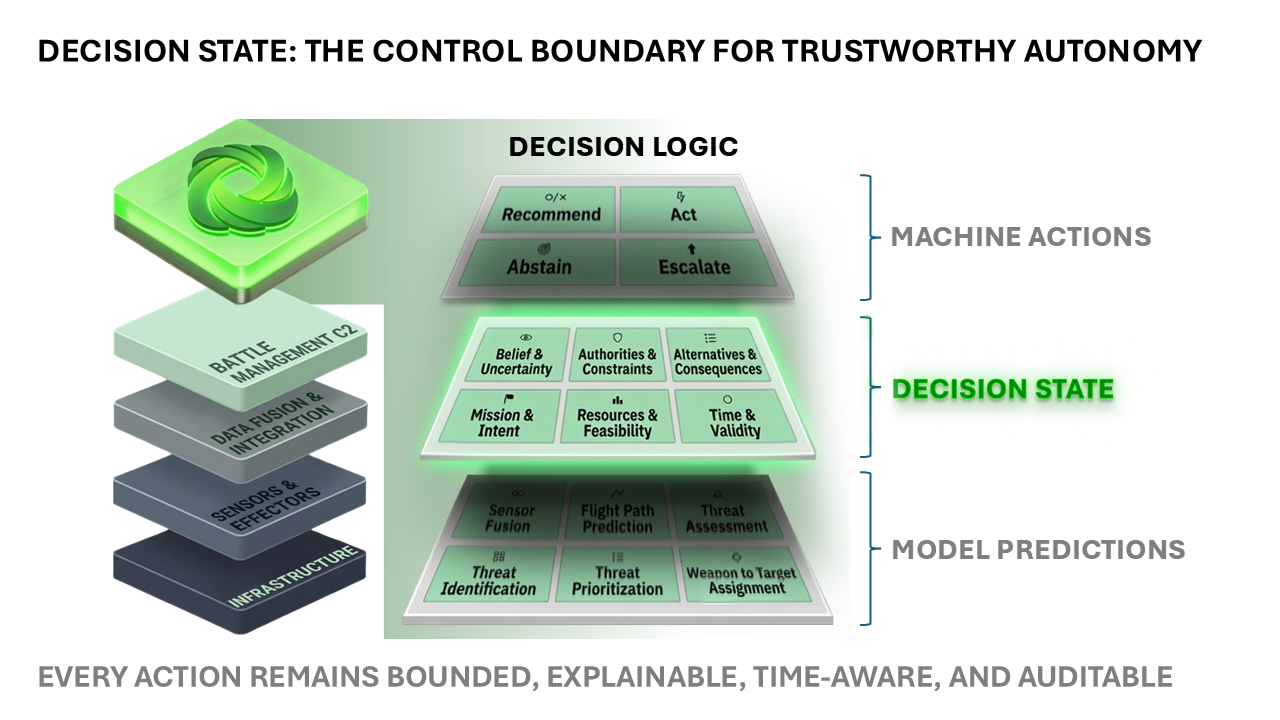
Reactor is Camgian’s answer: an AI-enabled Decision Logic platform for kill chain acceleration. Decision Logic is a distinct category of warfighting software: an independent governed reasoning layer that draws on information services and command execution. Where C2 systems maintain tracks and plans within the authoritative operational picture, Reactor maintains Decision State, a persistent, composable representation of what is believed, what matters, what is permitted, what is possible, what could happen next, and how much time remains to act.
Reactor is C2, sensor, and effector-agnostic by design. It integrates into existing and emerging architectures through defined boundary services and MOSA-aligned data connections, without requiring wholesale modification of the underlying command platform. Working alongside existing C2, Reactor:
- Fuses multi-modal data from across domains and maintains a continuously updated Decision State
- Prioritizes threats and re-tasks sensors according to the decision value of additional information
- Generates, constrains, and evaluates courses of action against mission objectives, authorities, magazine depth, and timing
- Orchestrates kill chains and delivers ranked recommendations through existing command interfaces
- Exposes evidence, assumptions, confidence, and rejected alternatives so every recommendation is explainable and auditable
Keeping this layer architecturally distinct from C2 matters. Mission-critical command platforms follow deliberately controlled update and certification cycles. Decision-making technology must keep pace with a faster-moving landscape of models, threat behaviors, and policy. A separate reasoning layer allows decision capabilities to evolve and be validated on their own cadence, and to be applied consistently across services, domains, and vendors, while preserving the underlying C2 investment and command authority. Humans remain in command. They command through governed, explainable, machine-speed reasoning.
The result is Decision Superiority: faster, more informed decisions, greater interoperability, and enhanced mission effectiveness across integrated air and missile defense, counter-UAS, integrated fires, and multi-domain operations.
Reactor® in Action: A Multi-Domain Scenario
Consider a layered air defense task force protecting a critical site. Within minutes, ground radars pick up a low-altitude drone swarm, a maritime sensor cues an inbound cruise missile from a second axis, and space-based warning flags a ballistic launch. Each feed arrives through a different system, on a different timeline, competing for the same operators, interceptors, and attention.
Today, connecting those feeds is a solved problem. Deciding across them is not. Operators must judge which threats matter most, which sensors to re-task, which effector to commit against which target, and in what order, while inventory, engagement windows, and rules of engagement shift by the second.
Working through the existing C2 architecture, Reactor maintains a single Decision State across all three threat axes. It prioritizes the raid as a whole rather than as separate tracks, evaluates feasible engagement options against interceptor inventory, timing, and authorities, and presents operators with ranked, explainable courses of action, each showing the evidence and assumptions behind it. The operator decides. Reactor ensures that decision is made with the full multi-domain picture, in seconds instead of minutes, and that no threat slips through a seam between systems.
About Camgian
Camgian is an award-winning developer of advanced artificial intelligence and machine learning defense technology solutions. We deliver real-time, actionable intelligence by harnessing cutting-edge machine intelligence. In today’s dynamic battlespace, across domains such as air and missile defense, space defense, and counter-UAS operations, our technology empowers Warfighters to achieve precision at the point of decision and respond faster to evolving threats.
To read the Northrop Gruman Press Release: Northrop Grumman and Camgian Collaborate to Advance AI Capabilities for Multi-Domain Integrated Air and Missile Defense | Northrop Grumman